American Beach
And Their Children After ThemAmerican Beach is a lakeshore gathering place in Heillange whose informal summer life and official celebrations repeatedly bring different parts of the town into the same space. Campfires, overnight stays, and chance encounters belong to its everyday tradition; on Bastille Day, fireworks and dancing turn the shore into a much larger public stage. The beach’s significance lies in this overlap: it offers room for intimacy and disorder, while also making visible the divisions and fleeting solidarities of the community around it.
Setting and Name
The name reaches back to the 1960s, when a man who ran a military-surplus shop and sold imported jeans built a drive-in at the site. He claimed to be from Texas, and that was enough to give the place its name. The cinema did not last, but American Beach remained the name people used, carrying a trace of a vanished attraction into the present-day landscape.
The shore is not simply a designated venue for organized events. It is also a familiar local destination, surrounded by several beaches where young people gather in summer. Residents park along the departmental highway, in fields, and even in the forest when large crowds arrive. The movement toward the water makes the beach a meeting point for people who otherwise appear in separate social groups: workers and executives, families and young people, locals and visitors from farther away.
Everyday Summer Use
In summer, young people come to the beaches around the lake on many evenings to light fires, drink, and sleep outdoors. Camping and drinking are formally prohibited, and Heillange City Hall puts up signs explaining the rules. Patrols sometimes issue fines. Yet the custom persists: the same place associated with nuisances and damage is also woven into residents’ memories of spending a night outside or sharing a kiss beneath the moonlight. Regulation exists, but it competes with a tradition that people across the town recognize as their own.
That informal use has consequences. Fires, fighting, wear on the beaches, and garbage prompt official efforts to discourage the gatherings. The friction is not resolved so much as repeated each summer: the authorities mark out what is forbidden, while young people continue to treat the shore as somewhere to meet and stay. American Beach therefore carries both sides of local public life, as a managed recreational area and as a place whose customs exceed the rules.
A Place for Private Encounters
The beach’s crowded summer setting can also contain moments of privacy. During one evening visit, Anthony Casati and Stéphanie Chaussoy walk along American Beach past small groups of teenagers talking, playing guitars, and flirting around their fires. They have to go some distance before finding a quieter place near a ring of blackened rocks. Anthony gathers branches and uses a crumpled newspaper to start a fire. The pair drink together and, although they have little to say, feel at ease in each other’s company.
The scene’s importance comes from the contrast between the public shore and the small space the two make for themselves. The fire and the darkness offer temporary shelter from the busy beach, while Anthony’s thoughts return to his father and the unsettled business at L’Usine. The setting does not remove that worry; it holds it alongside a developing closeness with Stéphanie. American Beach thus accommodates both sociability and withdrawal, without making either one permanent.
Bastille Day on the Shore
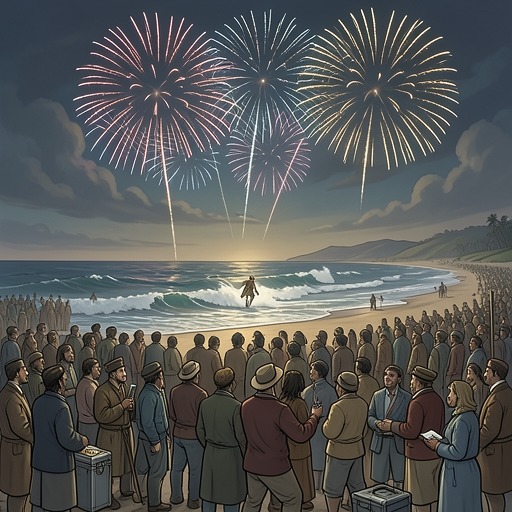
On Bastille Day, Heillange City Hall organizes a dance and fireworks at American Beach. The event draws a broad crowd, including people of different ages, occupations, and social backgrounds. Some arrive early with folding chairs and coolers to claim places by the water. A barge carrying rockets waits offshore. The formal program is assembled from practical arrangements: a stage for speeches, a sound check, a DJ rather than a live band, and a refreshment area where an authorized vendor sells food. Other sellers later try to trade from improvised barbecues and fryers, while officials generally look the other way.
The official program presents Heillange as a town with ambitions and attractions. The mayor praises local improvements and projects, and Pierre Chaussoy announces that the town will host a regatta the following summer. Yet the event’s shared character is not produced only from the stage. Around nine, after the music pauses for the speeches, the crowd gathers beneath the open sky; as night falls, the fireworks draw attention toward the lake. The spectacle briefly overcomes even the skepticism of Stéphanie and Clémence, who watch with the rest of the audience. When the display ends, the crowd turns toward drinks and dancing, and the atmosphere shifts from patient anticipation to exuberance.
The celebration also gathers private stories into its public scene. Anthony returns from the forest and finds Stéphanie and Clémence dancing; later, he dances closely with Stéphanie. Patrick Casati, exhausted and out of place amid the festivities, sees his son with a girl on the dance floor. The same event therefore means different things to those present: a civic occasion, a night of music, a moment of intimacy, or a reminder of distance within a family.
Local Memory and Collective Belonging
American Beach belongs to a lakeshore landscape marked by memories that are not always celebratory. A year before one account of the summer gatherings, a boy disappeared after the Bastille Day crowds and fighting at the lakeshore. Witnesses later described confusion and a boy who appeared to be hurt; searches followed in the woods and the lake. The account situates the disappearance amid a night of fireworks, campfires, barbecues, and conflict among several groups. It makes the lakeside celebration inseparable from the possibility of disorder, although it does not establish that the disappearance occurred specifically at American Beach.
The scale of the Bastille Day crowd also reveals the town’s social tensions. People arrive side by side despite differences that are prominent in ordinary life, and the public celebration can make that proximity feel, for a time, like common ground. Later, after France’s World Cup semifinal victory over Croatia, Heillange’s streets fill with flags, cars, embraces, and declarations of collective belonging. That outpouring is not an event at American Beach, but it echoes the beach celebration’s capacity to gather a diverse population around a shared spectacle. Neither gathering erases social differences; each shows how readily a common feeling can emerge, and how temporary that feeling may be.